Design your logs like an API
Business questions answered from CloudWatch Logs Insights: log-line contracts, why enriching an existing line beats adding a new one, JSON-escaping gotchas, and the retention trap.
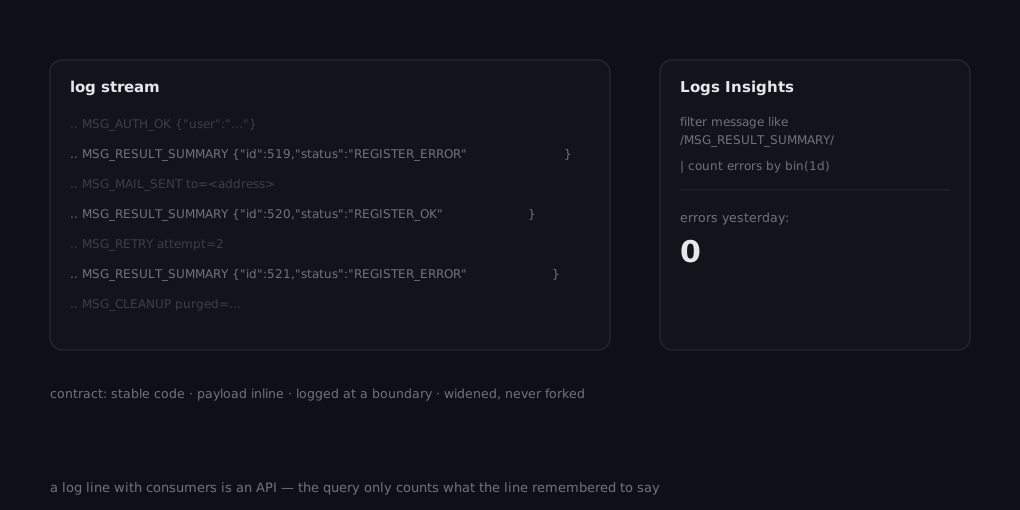
The question that changed how I write log lines was not technical. It was a stakeholder asking, “how many uploads failed yesterday — and how many of those were the customers’ own mistakes?” No dashboard had it. No table kept it — by design, processed records were purged on a schedule. The only artifact that reliably remembered was the logs, and whether logs can answer a business question depends entirely on decisions someone made months earlier, casually, while typing a log statement.
That’s the thesis: a log line consumed by queries is an API. It has consumers, a schema, and compatibility obligations — it just isn’t treated like one until the first hard question arrives.
What made the questions answerable
The platform was a serverless batch pipeline (Lambda, SQS stages) whose steps logged structured JSON with stable message codes. The lines that ended up mattering had three properties worth copying:
- A stable, greppable code per event type —
filter message like /MSG_RESULT_SUMMARY/survives wording changes;filter message like /finished processing/dies the first time someone “improves” the sentence. - The payload that matters, inline. The summary line for each processed batch carried the per-record outcomes —
[{"id":519,"status":"REGISTER_ERROR"}, …]— so a count is a query, not a join across systems. - Logged at a boundary, before anything else can fail. The summary was emitted at message-receipt, before validation could reject anything. Log lines that fire inside conditional branches inherit every bug of those branches.
With that, Logs Insights answered daily error/success totals in one query. Then the follow-up question — which failures belonged to which audience — exposed the limits.
Enrich the line you have, don’t add a new one
The outcome payload didn’t distinguish audiences (in our case: whether a failure notification went to an end customer or to an internal operator). The dispatch code knew; the logs didn’t record it. First attempt: emit a new log line at the decision point. It worked, and it was still the wrong call — review pushed back, and the pushback was right:
- A new line means every existing query, and every future consumer, must now correlate two lines per record.
- The new line can fire at a different rate than the old one (retries, partial failures), so counts drift subtly apart.
- The old line remains incomplete forever.
The better fix was one field: stamp "type":"user" or "type":"admin" onto each entry in the payload the summary line already logged. Every existing query kept working; the new question became a filter. Widening an existing contract beats adding a parallel one — the same rule as API design, for the same reasons.
Backward compatibility was also the same problem it always is: in-flight messages produced by the old code lacked the field, so validation had to treat it as optional. Schema evolution doesn’t stop being schema evolution just because the transport is a log stream.
The gotchas that cost real hours
- Serializer escaping breaks naive matching. Our logger emitted JSON; the payload was an array embedded in the message string, so its quotes arrived backslash-escaped in the raw line. The obvious query —
filter message like /"status":"REGISTER_ERROR"/— matched nothing. Counting bare tokens (and substring-length arithmetic for per-line counts) worked; assuming your log line looks like what you typed did not. Test queries against real stored lines, never against what the code appears to print. - Log timestamps live in UTC; your stakeholders don’t. Every “daily” count needs the timezone offset applied deliberately, once, in the query — not rediscovered per incident.
- Retention is a one-way door. The database was no fallback: operational tables were hard-deleted on a short schedule, and log retention had its own window. Whatever isn’t in the line when it’s written is unrecoverable for the entire pre-fix period. We could derive one audience cleanly for history (its address pattern was distinctive) but not the other — a permanent asymmetry caused by a missing field.
Make it a team asset
The queries themselves became a maintained, bilingual manual kept with the project: each recipe with the question it answers, the message code it depends on, and its known limits. Two effects. Tribal knowledge stopped being tribal — the person who wrote the query stopped being a dependency. And the manual functions as a consumer registry: before anyone edits a log line, one grep shows which questions break.
The checklist I now apply to any log line that might ever be counted: stable code, self-contained payload, emitted at a boundary, evolved by widening, verified against stored reality, documented with its consumers. It’s fifteen minutes of care per line — purchased at that price, or later at the price of a question you can no longer answer.