Multi-region DR you actually rehearse
Tokyo primary, Osaka standby, one Terraform module set: what to replicate, what to rehearse, and why an untested failover plan is a diagram, not a capability.
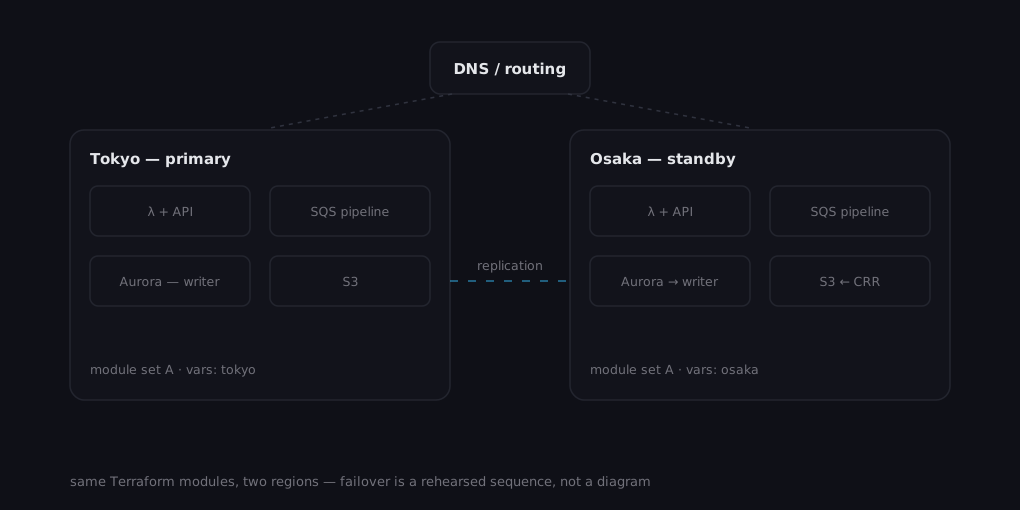
Disaster recovery is the part of the architecture I most hope is wasted work — and the part I least trust to hope. On an enterprise serverless platform I led — AWS Lambda and SQS pipelines over Aurora PostgreSQL, with strict recovery objectives in the contract — we ran Tokyo as primary and Osaka as standby. What follows is what actually made that real: not the diagram, but the decisions about replication, code, and rehearsal.
One module set, two regions
The foundational choice: Osaka is not a second project. It’s a second variables file.
All infrastructure lived in Terraform modules (about two dozen of them, spanning roughly ten environments), and both regions applied the same modules with different inputs. That sounds like standard practice — it is — but the discipline it enforces is the actual DR feature:
- No drift by construction. The standby can’t quietly diverge from primary, because there is no standby-specific code to diverge in. A security group change lands in the module and both regions get it on the next apply.
- The DR region is always buildable. The scariest DR posture is a standby assembled by hand two years ago. Ours could be torn down and re-applied, which meant we knew the recipe was complete — nothing lived only in someone’s console history.
- Cost control stays honest. Region-level inputs let the standby run lean (smaller instances, fewer replicas) while remaining structurally identical. The trade-off is explicit in a variables file instead of implicit in forgotten sizing decisions.
What replicates, and how fast
Not everything deserves the same recovery treatment. We sorted state into three tiers:
| Tier | What | Mechanism | Loss tolerance |
|---|---|---|---|
| 1 | Relational data (orders of record) | Aurora cross-region replication | Seconds of lag |
| 2 | Objects (uploaded files, generated artifacts) | S3 cross-region replication | Minutes, asynchronous |
| 3 | Derivable state (caches, queue backlogs) | Not replicated — rebuilt | Rebuild time |
Tier 3 is the one people argue about. Replicating queue contents across regions is complex and rarely worth it: an SQS backlog is in-flight work, and our pipeline stages were already idempotent (they had to be — at-least-once delivery demands it). On failover, upstream systems re-deliver or operators re-trigger, and idempotency absorbs the duplicates. We wrote that down as policy so nobody would burn a quarter building queue replication we didn’t need.
Compute, meanwhile, is the serverless dividend: Lambda functions and API definitions are just code and configuration, present in both regions by virtue of the shared modules. There is no warm fleet to keep patched.
The runbook is the product
The failover runbook was a numbered document, and its order was load-bearing:
- Declare — a named role decides failover has begun; ambiguity here costs more than any technical step.
- Freeze intake — stop accepting new work in the primary path so state stops moving.
- Promote — Aurora standby becomes writable in Osaka.
- Repoint — DNS/routing shifts traffic to the Osaka stack.
- Drain and reconcile — re-trigger interrupted pipeline work; idempotency handles the overlap.
- Verify — a scripted smoke sequence, not a vibe check.
Two lessons from rehearsing it:
- Rehearsal converts documentation into capability. The first walkthrough found steps that assumed access nobody had in an emergency and a promotion step whose duration surprised everyone. None of that appears on a diagram; all of it appears on a stopwatch.
- Measure the rehearsal against the objectives. RTO and RPO were contractual numbers. The rehearsal either fits inside them or the architecture goes back for revision — that feedback loop is the entire point of having numbers.
The unglamorous perimeter
DR reviews obsess over databases and skip the boring dependencies that make a region actually usable: the four-tier VPC layout, network firewall rules, IAM, KMS keys, monitoring, and alarms all had to exist in Osaka before the bad day — several of those are region-scoped in ways that surprise people, and every one of them was in the modules for exactly that reason. The audit stack too: if the primary region is down, the evidence trail (CloudTrail, VPC Flow Logs, the Athena tables over them) must not be.
The takeaway I’d hand to a team starting this: treat DR as a product feature with an owner, a budget, and a test cadence. The technology — Aurora replication, S3 CRR, Terraform symmetry — is well-trodden. What separates a capability from a diagram is that someone rehearsed it, timed it, and fixed what the stopwatch found.