Serving ML recommendations inside a LINE mini-app
The architecture behind a property-search platform delivered entirely through LINE — Go backend, LIFF mini-apps, an XGBoost inference service, and the batch pipelines that keep recommendations fresh.
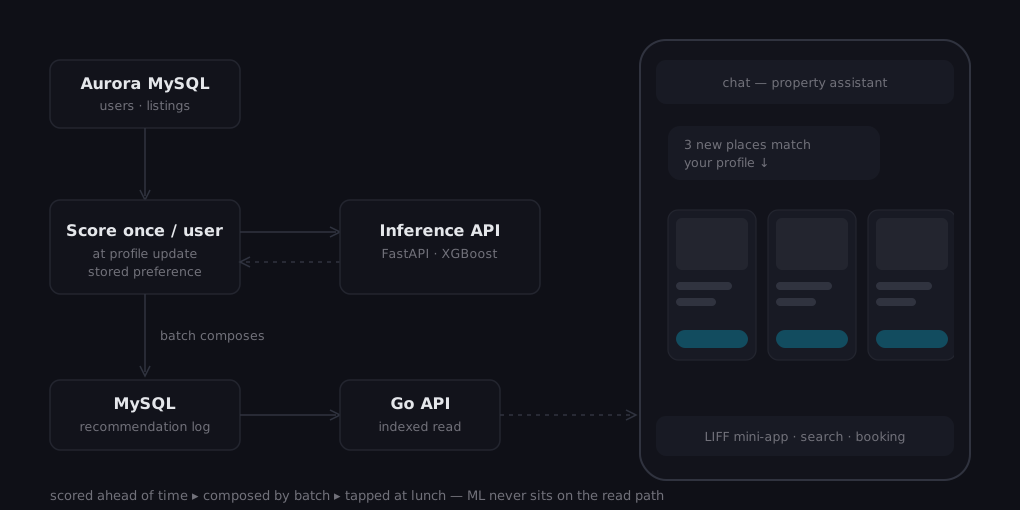
Ask me what powers a recommendation system, and the honest answer is: mostly not the model. The part of this one I’m proudest of isn’t the scoring — it’s that a score computed long before anyone asked reliably became a card someone tapped in a chat thread at lunch. That path — score to message, cheap, dependable, inside a chat platform’s constraints — is where most of the engineering lives.
I built and ran the backend of a real-estate discovery platform delivered entirely through LINE — no native app, no standalone website for end users. Search, favorites, tour booking, and personalized property recommendations all lived inside chat and LIFF mini-apps. Here’s how the recommendation path actually worked, end to end.
The overall architecture
Four services, each with one job:
| Component | Stack | Role |
|---|---|---|
| Main backend | Go / Echo | ~60 REST endpoints for the LIFF apps; owns users, listings, reservations |
| Inference service | Python / FastAPI / XGBoost | Scores a user’s attributes into a stored preference profile |
| Admin panel | PHP / Laravel | Internal ops: listings, reservations, staff |
| Batch jobs | Go on ECS (scheduled tasks) | Recommendation precompute, notification campaigns, master-data import |
Data lived in Aurora MySQL; infrastructure was ECS Fargate behind an ALB with WAF and CloudFront, all managed with Terraform, with an external property-management system integrated over authenticated REST for listing data and reservation sync.
The Go/Python split was deliberate. The data-science side needed the Python ecosystem — the model was XGBoost, trained on user demographics, geography, and interaction history. The product side needed Go’s concurrency and deployment simplicity for the API tier. Drawing the boundary at “the inference service scores; the backend decides” kept both teams fast.
Why gradient boosting, not embeddings
The catalog was new-build properties: a few thousand active listings, each rich in structured attributes (location, price band, layout, developer, completion date). Users arrived with structured attributes of their own — family composition, workplace area, budget signals. This is tabular-matching territory, and gradient-boosted trees on engineered features beat fancier approaches on data like this while staying explainable and cheap to retrain.
The feature vector for a (user, property) pair combined:
- User attributes — demographics, declared preferences, home-area geography
- Property attributes — price, size, station distance, completion timing
- Interaction features — the crosses that carry most of the signal: budget fit, commute-geography match, layout vs. household size
- Behavioral signals — favorites, viewed listings, tour history
Cold start — most users, since people don’t shop for homes weekly — degraded gracefully to attribute matching alone, which is exactly the regime where a tree model is comfortable.
Precompute, don’t score at request time
The single most important architectural decision: recommendations were computed ahead of the request, not during it.
The model ran once per user — at profile registration, scoring their attributes into a preference profile stored alongside the user. Scheduled ECS jobs then did the assembly: walk users, build candidate sets (geography and budget filters cut thousands of listings down per user), match them against the stored profile, and write ranked results to a recommendation log in MySQL. The API tier — and the chat bot — served recommendations as an indexed read over that log, recomputing from the stored profile only on a miss. The inference service never sat on the read path at all.
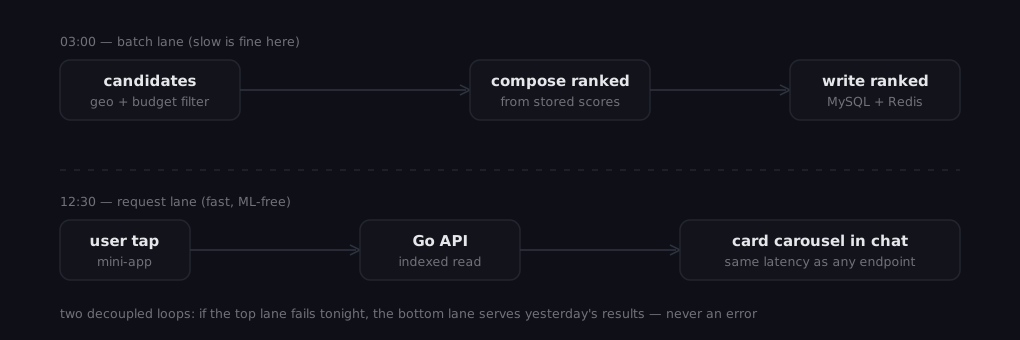
Real-time scoring was the more sophisticated-sounding option. Precompute won on every axis that mattered here:
- Freshness didn’t require it. Property inventory changes daily, not per-second. Weekly and twice-weekly recommendation passes over a nightly master-data-and-scoring refresh were genuinely fresh enough.
- Failure isolation. If the inference service fell over, profile updates degraded — but recommendations kept serving from stored results, and users never saw an error. In a request-path design, an ML outage becomes a product outage.
- Push notifications need batch anyway. The campaign pipeline — “new properties match your profile” — walks users, checks scores, and sends messages. That is a batch job; making the serving path share its output meant one recommendation source of truth instead of two drifting ones.
The LINE delivery layer
The chat platform is not a browser, and treating it like one produces clumsy products. The pieces that mattered:
- LIFF mini-apps for anything form-like or list-like — search, filters, favorites, booking. From the backend’s perspective they’re just web clients hitting REST endpoints with a platform ID token; verify the token, map the platform user to your user, proceed as normal.
- Flex Message carousels for recommendation delivery in chat. A recommendation push isn’t a link — it’s a swipeable card carousel rendered natively in the conversation, each card deep-linking into the LIFF detail view. Click-through lives or dies on this rendering.
- Rich menu + chatbot flows as navigation, so users could reach every feature without ever typing.
- Rate-limited push campaigns. Messaging APIs meter you, and users churn hard on notification spam. Campaign batches were throttled, deduplicated against recent sends, and capped per user per period. On a chat platform, over-messaging is the fastest way to lose the channel entirely — the user blocks you and every future recommendation with you.
One operational lesson from the API tier: with Go’s concurrency it’s tempting to fan out — score check here, favorite lookup there. Most of our production issues in that layer were nil-safety and lock-contention bugs from unnecessary parallelism. Boring sequential handlers with Redis in front turned out faster and more debuggable than clever ones.
What made it work
Looking back, the system’s quality came from three boundaries, not from the model:
- Inference is a service with an API contract — the model can be retrained, swapped, or A/B’d without the product tier knowing.
- Serving is decoupled from scoring — batch precompute means user-facing latency and ML availability are independent problems.
- The channel is a first-class constraint — recommendations were designed for how people actually receive them (a card carousel in a chat thread), not as an afterthought bolted onto a generic API.
The model was maybe 20% of the work. The other 80% was making sure a score computed ahead of time became a card a user tapped at lunch — and that nothing between those two moments could take the product down.
This post anchors a short series on the same platform: Building a product where the UI is a chat thread, The push pipeline that didn’t get blocked, and The lock contention that wasn’t in the query plan.