Event-driven microservices without losing events: the transactional outbox in practice
How we kept orders, payments, and downstream services consistent on Cloud Run and Spanner using the transactional outbox pattern and task-queue relay workers — and what we'd do differently.
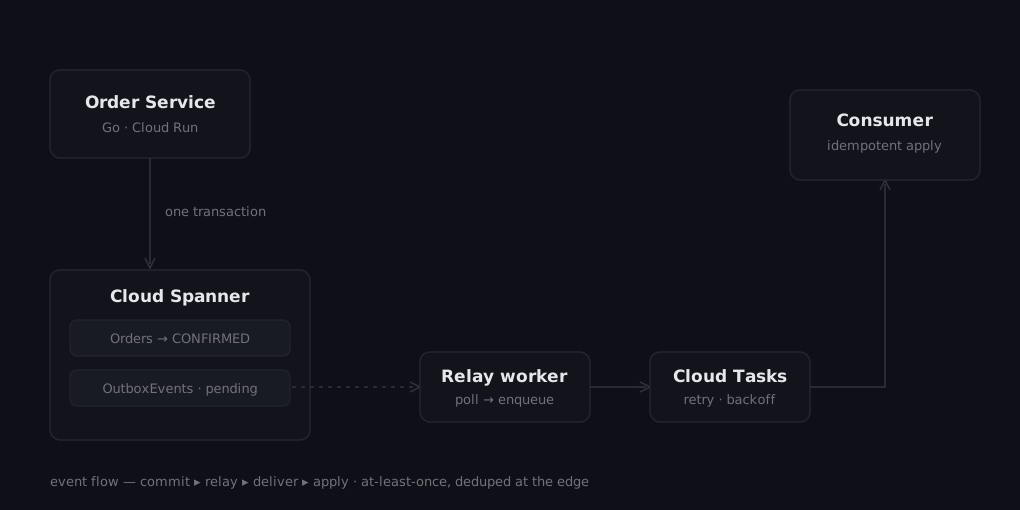
My least favorite class of production bug doesn’t crash anything. A payment gets captured, an order stays frozen, no alarm fires — the system just quietly disagrees with itself. And nearly every time I’ve chased one, it traced back to two innocent-looking lines of code: commit the row, then publish the event. If the process dies between those two lines, downstream services never hear about the order. Flip the order, and a rollback means they hear about an order that doesn’t exist.
On a consumer e-commerce platform I worked on — Go microservices on Cloud Run, Cloud Spanner as the primary database, roughly a dozen services orchestrating multi-step purchase flows against several downstream systems including a payment gateway — the dual write was exactly the failure mode the money path could not afford: a payment captured with no corresponding order transition, or an order stuck waiting for an event that was never published — drift you discover in a reconciliation query, not an alert.
The fix was boring, well-documented, and completely effective: the transactional outbox.
The core idea
Instead of publishing to a message bus as a side effect, you write the event into the same database transaction as the state change:
-- One Spanner read-write transaction
INSERT INTO Orders (OrderId, Status, ...) VALUES (@id, 'CONFIRMED', ...);
INSERT INTO OutboxEvents (EventId, Topic, Payload, CreatedAt, PublishedAt)
VALUES (@eventId, 'order.confirmed', @payload, PENDING_COMMIT_TIMESTAMP(), NULL);
Either both rows exist or neither does. The database’s atomicity — the one guarantee you already paid for — now covers your messaging too.
A separate relay worker then reads unpublished rows and pushes them out. We used Cloud Tasks as the delivery mechanism: the relay enqueues a task per event targeting the consumer’s endpoint, marks the row published, and lets the task queue handle retries with exponential backoff.
func (r *Relay) Tick(ctx context.Context) error {
    events, err := r.repo.FetchUnpublished(ctx, batchSize)
    if err != nil {
        return err
    }
    for _, ev := range events {
        if err := r.tasks.Enqueue(ctx, ev); err != nil {
            return err // leave the row; next tick retries
        }
        if err := r.repo.MarkPublished(ctx, ev.ID); err != nil {
            return err // task may fire twice — consumers must dedupe
        }
    }
    return nil
}
That comment on the last error path is the whole contract: the outbox gives you at-least-once delivery, never exactly-once. If the relay crashes between enqueue and mark-published, the event goes out twice. Chasing exactly-once at the transport layer is a losing game; you push the problem to consumers instead.
Idempotent consumers are half the pattern
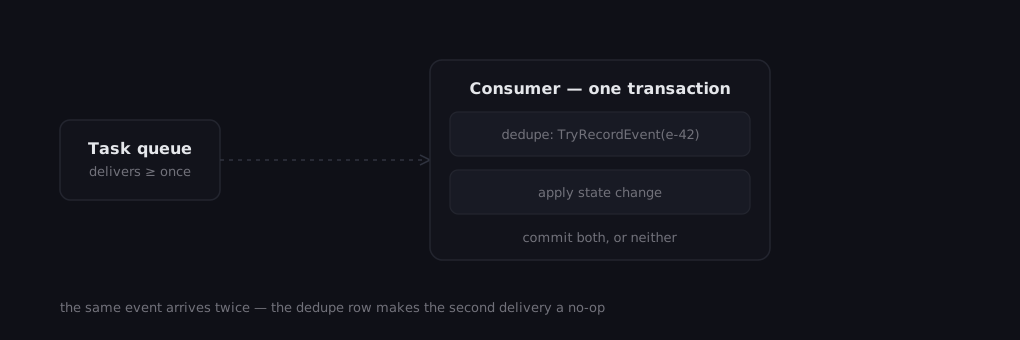
At-least-once delivery only works if redelivery is harmless, and each domain enforced that in its own terms — the relay checks a published flag before enqueuing and swallows the task queue’s duplicate error; the payment path dedupes on an idempotency key per request. The shape that generalizes, and the one worth copying, is a dedupe record committed with the state change:
// Inside the consumer's own transaction
applied, err := s.repo.TryRecordEvent(ctx, ev.ID) // INSERT OR IGNORE semantics
if err != nil || !applied {
    return err // duplicate — ack and move on
}
// ... apply the state change in the same transaction
The dedup record and the state change commit atomically, which means the consumer has its own miniature outbox-in-reverse. Wherever a consumer held this line, duplicates became a non-event — literally.
Orchestrating multi-step flows
Purchase flows spanned several services: reserve inventory, authorize payment, confirm the order, trigger fulfillment, send notifications. We deliberately did not reach for a saga framework. Each step was an event → idempotent handler → next event chain, with the outbox guaranteeing no link ever silently dropped.
Two design rules kept this manageable:
- Events carry facts, not commands.
order.confirmed, notsend_email_please. Consumers decide what a fact means for them, which keeps producers ignorant of their audience and lets you add consumers without touching the producer. - Every flow has a single owner service. One service owns the order state machine and is the only writer of order-lifecycle events. Others react. When something goes wrong at 2 a.m., there is exactly one place to look for “what state is this order actually in.”
For the payment gateway specifically, we isolated all card, wallet, and convenience-store payment methods behind a dedicated gateway-abstraction service. External payment providers have their own retry semantics, callbacks, and failure vocabulary; letting that leak into the order service would have coupled our core state machine to a third party’s quirks. The gateway service translated provider callbacks into the same clean internal events everything else consumed.
Operational notes
A few things that mattered more in production than in the design doc:
- Outbox table growth. Published rows were deleted by a scheduled job after a retention window. Spanner handles large tables fine, but an unbounded outbox slows the relay’s
FetchUnpublishedscan. Index on(PublishedAt, CreatedAt)and keep the working set small. - Ordering. Task queues don’t guarantee order. Where sequence mattered (state machine transitions), consumers validated the transition rather than trusting arrival order — an out-of-order
order.shippedbeforeorder.confirmedgets parked and retried, not applied. - Observability. The relay exports
oldest_unpublished_ageas a metric. That single gauge catches almost every failure mode: relay stuck, task queue backed up, consumer erroring. Alert on age, not on queue depth. - Context cancellation. One subtle production bug: an outbound HTTP call wrapped in a goroutine kept running after the request context was cancelled, producing half-applied side effects. The fix was to stop being clever — propagate the caller’s context and let cancellation actually cancel.
What I’d do differently
If I were starting again, I’d generate the outbox plumbing. We hand-wrote the relay and repository code per service early on, and the drift between implementations caused most of the friction. We later consolidated on a shared internal library plus a DAO code generator, and the pattern became nearly free to adopt.
I’d also introduce the pattern before the first consistency incident, not after. The outbox costs one extra table and one small worker. The alternative costs you a weekend reconciling order and payment records with a SQL script — and your users’ trust in checkout.
Dual writes are a bug you haven’t hit yet. Write the event in the transaction.
This post anchors a short series on the same platform: One interface, four ways to pay, Service-to-service auth without a service mesh, and When a goroutine is the wrong tool.